


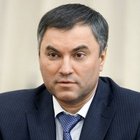
The meeting was attended by Chairman of the State Duma of the Russian Federation and Chairman of the Parliamentary Assembly of the Collective Security Treaty Organisation Vyacheslav Volodin; Chairman of the House of Representatives of the National Assembly of the Republic of Belarus Igor Sergeyenko; Chairman of the Mazhilis of the Parliament of the Republic of Kazakhstan Yerlan Koshanov; and Chairman of the Majlisi Namoyandagon of the Majlisi Oli of the Republic of Tajikistan Faizali Idizoda.
* * *
President of Russia Vladimir Putin: Good evening, colleagues,
I am very glad to see and welcome you, and to congratulate you on successfully holding another session of the Parliamentary Assembly of the Collective Security Treaty Organisation.
I am aware that you have thoroughly discussed all current issues and even took a glimpse into the future. I see, we are aware of it, and I discuss it with my colleagues as well, that all members of the organisation are firmly committed to strengthening its standing and its role in international affairs.
As you are aware, the CSTO chairmanship will go to the Russian Federation next year. Without a doubt, we will do our best to reinforce the organisation. As I recently told my counterparts, other heads of state, we will, without a doubt, build up on what our friends from Kyrgyzstan have accomplished; it will be a full-scale continuation of their efforts across all core cooperation areas. These priorities are clear and include strengthening our defence capability and aligning our policies in the sphere of military activity and military-technical cooperation.
The Parliamentary Assembly was created almost 20 years ago, in 2006, and indeed makes a serious and sizable contribution to improving and harmonising legislation among our countries in the field of defence and security. I would like to highlight the model law on combatting terrorism, which is a critical element of the regulatory framework without which it is very difficult for us to make any practical decisions. The credit for this goes primarily to you and your colleagues who worked on this regulatory act and adopted it in conjunction with you, under your leadership.
The Assembly traditionally does a lot to monitor elections. I believe this is extremely important for ensuring the stability of the domestic political agenda. There is no need to explain how important this is. You understand it perfectly well. And I would also like to thank you, because the creation of such representative and highly respectable monitoring groups helps each of our states to handle, first, these crucial election campaign-related stages and, second, it underscores the legitimacy of the political processes unfolding in our respective countries.
Joint political statements also matter. The statement on ensuring security in a multipolar world you adopted today is also of major importance and sends a very strong signal outwards.
A new five-year programme for inter-parliamentary cooperation has been adopted which shows we do not just react to the latest developments in our work, but we go farther to cover at least a medium-term horizon. This makes our work stable and predictable and creates proper conditions for productive efforts at the level of executive authorities.
Thank you very much; I appreciate your attention.
Mr Volodin, please.
Chairman of the State Duma of the Russian Federation and Chairman of the Parliamentary Assembly of the Collective Security Treaty Organisation Vyacheslav Volodin: Mr President,
You have, in principle, said it all and outlined the tasks to be addressed by the Parliamentary Assembly of the Collective Security Treaty Organisation.
I would like to emphasise one thing which is we, without a doubt, find it important when heads of state pay attention to the parliamentary dimension. So, when it comes to the Parliamentary Assembly, it can operate effectively only if it implements the tasks set out in the agenda of the heads of state.
In fact, this is how we see our work; we structure it that way, because we understand that the formation of a legal framework for the Collective Security Treaty Organisation is our top priority. All our decisions are made by consensus. This process is not easy. Sometimes it takes a long time to make one, but we arrive at decisions that are then implemented within national legal systems.
Seven model acts were adopted during the CSTO Parliamentary Assembly meeting today. If you look at the number, it is not a lot compared with a session of a national parliament. But in fact, it is the result of a lengthy coordination process and the time it took to develop the decisions, following which the act was adopted. This means that all countries supported it, and it was agreed upon by everyone, including executive authorities.
Speaking of the past work, the legal framework of the Collective Security Treaty Organisation currently consists of 104 documents which have been adopted over the past years. Speaking of the five-year period – we reviewed the results today – 35 legal acts and model laws of various formats have been adopted.
Regarding future plans, the programme was discussed today as well. We reviewed it thoroughly, and set for ourselves the goal of developing and adopting 45 model acts over the next five-year term. In other words, we are improving the efficiency of our work.
But I would like to emphasise once again that we find it important for these model acts to not remain at the level of parliamentary decisions within the Assembly. It is a good thing when they get extrapolated to national legislations. That means we share a common understanding of issues related to combatting terrorism, preventing drug trafficking in our countries, or matters related to the security of other segments.
Today, we also discussed information technology and artificial intelligence. When we talk about this, we must, of course, do everything to create a legal framework. On the one hand, we must support and develop these technologies, but on the other hand, there are challenges and problems we face today.
In an EU country, they went so far as to appoint AI to be a minister, and it has already been charged with embezzlement. There are no basic laws regulating issues related to artificial intelligence, robots, and humans.
And, of course, when it comes to the Collective Security Treaty Organisation, we need to create a legal framework so that a particular area can, on the one hand, develop effectively, and on the other hand, not cause harm to people. We must exchange opinions and look for best practices. In this regard, the parliamentary format is extremely effective, because we enlist a large number of experts and examine how these issues are addressed in Kazakhstan, Belarus, Tajikistan, and Kyrgyzstan.
You accurately noted that next year marks the 20th anniversary of the Parliamentary Assembly. We, for our part, will do our best to analyse the path we have travelled and outline future tasks.
The legislative support of the decisions of the CSTO Council of Heads of State remains our top priority. You mentioned this, and we are following the agenda of the earlier adopted decisions and do everything on our part to ensure that the parliamentary dimension is effective.
Thank you.
<…>