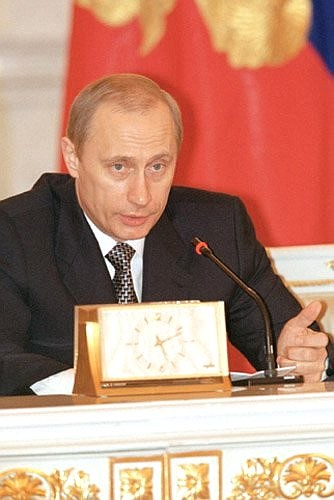
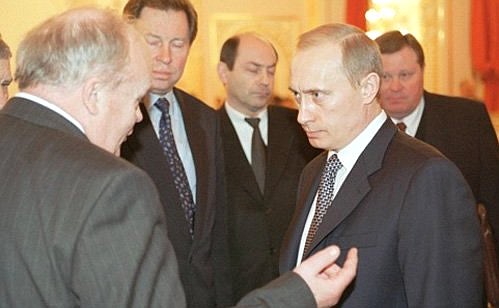
Addressing the meeting, the President urged the need for a fresh departure in the state’s policy on science. He indicated that the policy must be such as to make it advantageous for everyone to support and develop science.
The choice of scientific goals, he said, was effectively a choice of national goals, and directly linked to the protection of national interests and the choice of areas for strategic development.
In the President’s view, the most advanced areas of research concerned biomedical technologies, new medicines, DNA-related diagnostics, and the creation of transgenic plants. They also included new power generating techniques and resource-saving technologies, as well as crisis prediction and visions of the future. The President described these areas as a real and a very profitable sector of the economy, adding that Russia was still unable to make most of it.
Russia was still often forced to develop import-substituting technologies to catch up with others, the President said. Ideally, however, science must contribute to domestic market stability and offer new products and technologies.
President Putin said that Russia boasted only fragments of small-scale innovatory entrepreneurship, little venture capital and few other risk-related investments in research projects.
The President believed that an innovatory model of science organisation was needed that was on a par with the times and the condition of the market economy. He thought the way to do so was to introduce ring-fenced funding for whole productive areas rather than for organisations, and use clearly itemised government contracts.
Another aim of the state’s policy in that field, according to the President, was to take an inventory of the massive infrastructure of science, its considerable material basis and personnel.
The President criticised the state policy of recent years in that sphere. An unwanted science was a heavy burden on the public coffers, he said. To make it wanted, he said, the state needed minimum costs and maximum effort to develop an innovatory market.
The President said the problem of scientific personnel was a critical one. Since 1991, the number of researchers in Russia has halved, with 800,000 people, primarily young specialists, leaving the sciences over the past five years. In order to solve this problem, both funding and social guarantees are necessary, aided by an increase in the social status of scientists and scholars and the high prestige of research work.
He also called for bridging the gulf that has evolved over the ages between academic, applied and university research.
Another scientific problem, the President said, was the condition of scientific equipment in Russia, the average age of which is 15 years, while abroad the figure was five to seven years.
President Putin instructed the Government to draw up a timeline for scientific allocations until 2010, with allocation growth figures to be fixed as percentage points.